The first question almost everyone asks, right off the bat, is whether they need a lawyer at all. It usually arrives before any of the others, before anyone has thought about fees or deadlines or what a case is worth, because it is the question that decides whether the rest of it matters.
I have a straightforward answer, and it is not the one people expect from a personal injury attorney.
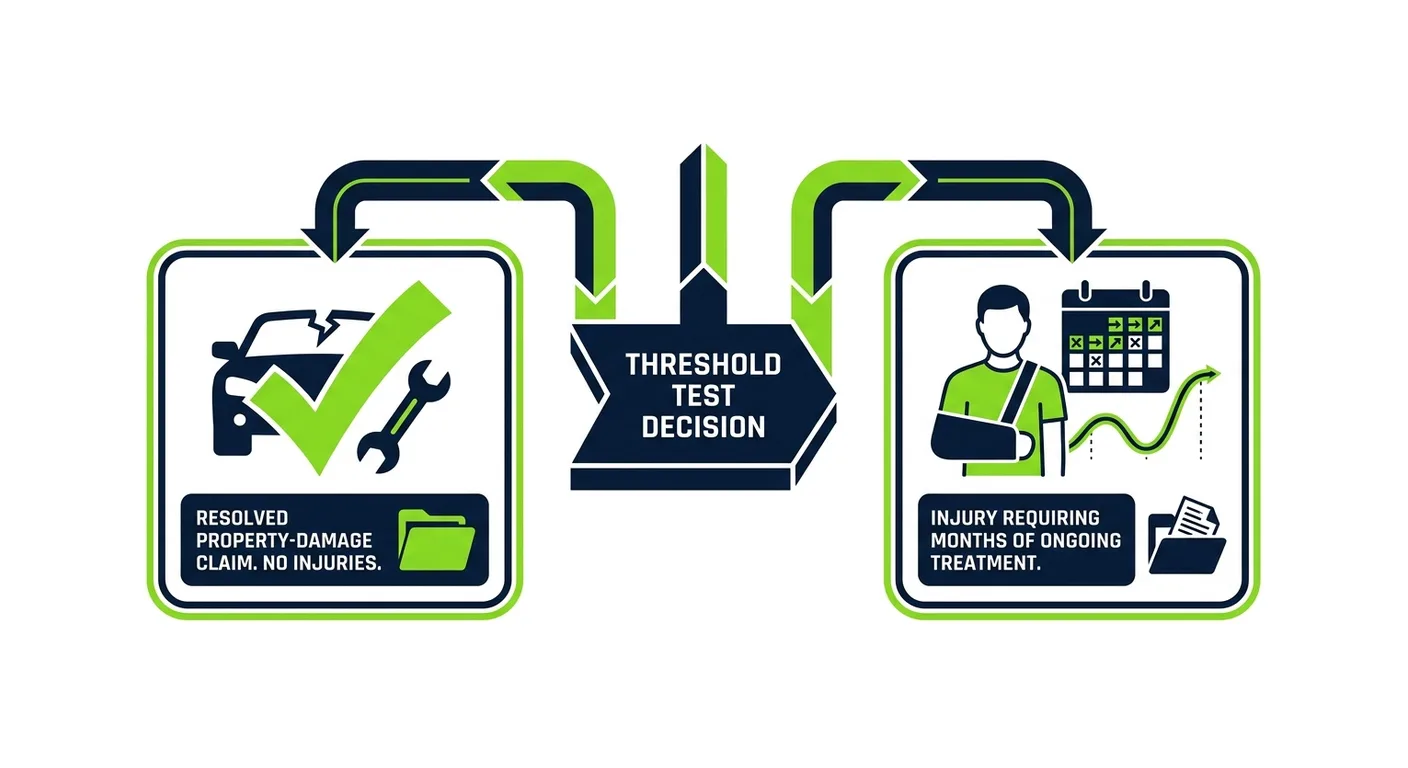
If the property damage is being handled, if nobody is hurt, and if a quick couple of thousand dollars is genuinely enough for you for the rest of your life, then you might not need a lawyer. You probably do not. It might not even be worth it. That is a real category of case and it comes through the office regularly.
But if you have extensive medical treatment ahead of you, or if you are looking at care that will run for a few months, that is a different situation entirely and should be handled differently.
If getting a quick couple thousand dollars is enough for you for the rest of your life, or you have no injuries and everybody's taking care of your car accident property damage situation well, then you might not need a lawyer. You probably don't. It might not even be worth it. But if you have any extensive medical treatment needed, if you have treatment that's going to be needed for a few months, I would say you need a lawyer.
The Real Test Is Risk, Not Injury Type
People want a list. They want to know which categories of accident require an attorney and which do not, as if the answer lies in the type of collision.
The simple answer is risk. Meaning, if you want to put no pressure on the other side, no pressure on the insurance company, then you do not need a lawyer. If they are simply giving you everything you ask for, then you have done it, you have cracked the code, and you probably do not need anyone's help.
I have never seen it in twenty years.
That is not a rhetorical flourish. It is an observation about how claims departments operate. An insurance company is an organization with a financial interest in closing your file for the smallest defensible number, and it has professionals whose full-time job is to do exactly that. The question is not whether they are being unpleasant to you. Most adjusters are perfectly pleasant. The question is whether anything in the situation is creating pressure on them to move.
Future Medical Treatment Changes the Calculation
The clearest dividing line in this analysis is medical treatment, and specifically treatment that continues into the future.
A claim in which you were checked out, released, and sent home has a knowable ceiling. A claim where you are going to be treating for months is not, because the full cost of the injury is not yet visible. Nobody knows yet what the imaging will show, whether the pain resolves or becomes permanent, whether you will be able to do the work you did before, or what care you will still need a year from now.
Settling that claim early means settling it for a number built on incomplete information, and once it is settled, it is finished. And so the presence of ongoing treatment is not just a factor in the decision. In most cases, it is the decision.
If you have any significant injury or any concern about your health in the future, you absolutely should hire a lawyer.
What Handling It Yourself Actually Involves
There is a version of this decision that gets framed as saving money, and it is worth being honest about what the unrepresented path actually requires of you while you are hurt.
It means being the person who talks to the adjuster, who decides what to say and what not to say, who tracks which bills went to which insurer, who knows when a deadline is running and which deadline applies, and who eventually has to judge whether the number being offered is a good number without having seen what similar cases resolve for.
Some people can do that. Most people, in the weeks after a serious accident, are not in a position to do it well, and that is not a failure of intelligence. It is a matter of what someone can reasonably manage while being treated.
Proposition 213, and Why Your Own Insurance Matters Before the Crash
There is one California rule that can change your case more than anything else in this book, and almost nobody knows about it until it applies to them.
If you were driving uninsured when you were hit, California law bars you from recovering non-economic damages. That is Proposition 213, and it means no compensation for pain, for suffering, for the loss of the things you used to do. You can still recover your medical bills and your lost wages. The human side of the claim is gone, even if the crash was entirely the other driver's fault.
The same bar applies if you were convicted of driving under the influence in connection with the crash, and to the owner of an uninsured vehicle.
There are exceptions to Prop 213 worth asking about, including if the at-fault driver was convicted of DUI, if the crash happened on private property and whether the uninsured vehicle belonged to your employer. But the general rule is hard, and it is the best argument I can make for carrying insurance you hope never to use.
The Coverage Most People Do Not Know They Have
The other half of that question is what the driver who hit you was carrying, and the honest answer is often not enough.
California raised its minimum liability limits on January 1, 2025. The minimum is now thirty thousand dollars for one injured person and sixty thousand dollars for everyone injured in the crash, with fifteen thousand dollars for property damage. Before that date, the minimum was fifteen thousand per person. Those numbers are scheduled to rise again in 2035. Thirty thousand dollars is a real improvement, and it is still nothing against an expensive surgery or a year out of work.
Which is why the most important policy in a serious case is frequently your own. Uninsured and underinsured motorist coverage is optional coverage you buy on your own policy, and it pays when the person who hit you had nothing or had too little. Most people do not know whether they carry it. It is worth finding out tonight rather than after a crash.
Two things to understand about how this works in California. Underinsured coverage is offset, not stacked, so it pays the difference between the other driver's limits and your own rather than the full amount on top. And it carries its own deadline, covered in Chapter 8, which people miss more often than the statute of limitations itself.
If the Crash Was Partly Your Fault
People often talk themselves out of calling because they think they did something wrong. Maybe they were going a little fast. Maybe they looked down.
California is a pure comparative fault state, which means fault gets divided rather than assigned to one single person. If you were to be found thirty percent responsible, you recover seventy percent of your damages. Even a driver who is found mostly at fault still recovers something. Being partly at fault is a reason to have the conversation, not a reason to skip it.
Common Questions
- Do I need a lawyer for a minor car accident in California?
- Not necessarily. If nobody was injured, the property damage is being handled well, and the amount on the table is genuinely enough, you may not need one. Robert May's position is direct on this point: in that situation, you probably do not need a lawyer, and it might not even be worth it. The analysis changes as soon as injuries and ongoing medical treatment enter the picture.
- What kinds of car accident cases almost always need an attorney?
- Cases with meaningful injuries, and especially cases where medical treatment is going to continue for months. The test is risky. If there is anything significant, or any concern about your health going forward, that is the category where representation matters, because the full value of the claim is not yet knowable.
- Can I just negotiate with the insurance company myself?
- You can. The question is whether anything in that negotiation creates pressure on the insurer to move off its number. As Robert May put it: "If they're just giving you everything you ask for, then you've done it, you've cracked the code, you probably don't need anyone's help." In twenty years of practice, he has not seen that happen.
- Is it worth hiring a lawyer if my injuries seem minor now?
- It depends on whether the injuries are actually resolved or simply early. Injuries that seem minor in week one sometimes require months of care, and a claim settled before that is known cannot be reopened. If treatment is ongoing or expected, the case should be evaluated before anything gets signed.
Chapter Reflection
The decision is not about whether you are the kind of person who hires a lawyer. It is about whether your situation carries a risk that nobody is currently applying pressure to. If it does not, keep your money. If it does, the rest of this book is about what that representation costs, what the clock actually looks like, and what happens once someone is working the case on your behalf.