Once you have hired The May Firm, you immediately have a team of people working behind the scenes to advance your case as quickly as possible. Most of it happens without the client seeing it, which is why this chapter exists.
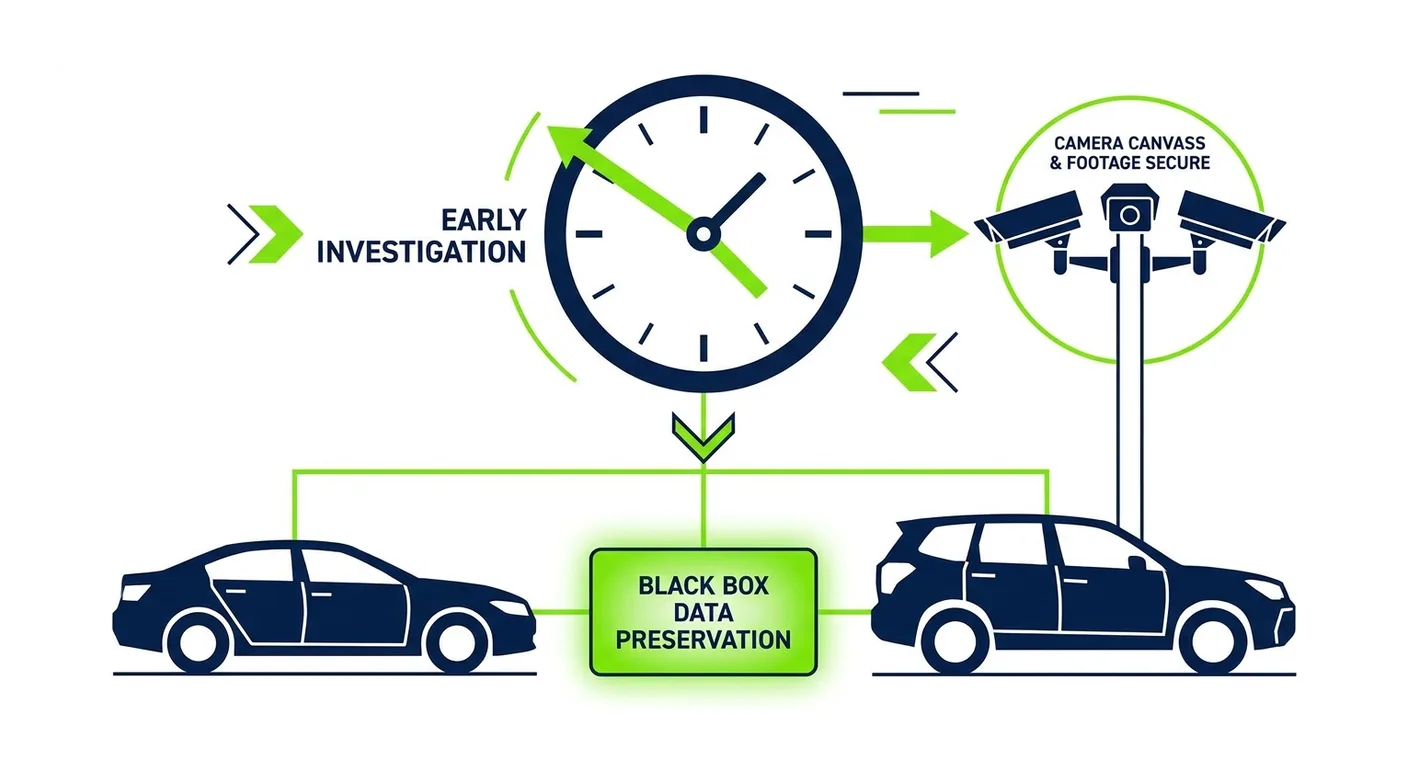
That might mean immediately making sure you, as the client, have medical care. It can also mean immediate investigation, something as simple as getting a traffic report, or as complicated as getting an accident reconstructionist on-site to take measurements and photographs that will be used to prove liability or even the causation of injuries.
All of these things are generally happening right away, in the first days, because most of them cannot be done later.
Oftentimes in modern society, there are so many cameras available. You can prove cases, but not with just a police report, not with a he-said, she-said, but with real evidence. But you have to be very proactive, you have to know how to get that information, and you have to get out there and get it right away.
Preserving the Vehicles
Depending on the case's complexity, you investigate it by sending team members, experts, or lawyers to the scene and ensuring the vehicle is preserved.
That can also mean taking black-box data from the car itself and having it analyzed. Most modern vehicles carry an event data recorder that captures speed, braking, and seat belt use in the seconds before a collision, and it can be downloaded. That gives you an actual record of what happened inside that car rather than an account of it.
The same applies to the other vehicle. Preserving it for the same information is part of the attempt to prove who was at fault and what really happened.
This is time sensitive in an unforgiving way. Vehicles get repaired, sold for salvage, or crushed. Data gets overwritten. A car released to an insurer three weeks after a crash may be gone in the sense that matters, and no amount of later work recovers it.
Canvassing for Cameras
The other early priority is finding video, and it is worth understanding how broad that search is.
Being on-site means finding out whether any cameras are available. Cameras on the highway if you are in Long Beach. Cameras at an intersection. Cameras at a drugstore, at a liquor store, even. Those have made the difference in cases because, after the accident, nobody involved wants to be held responsible.
That last point is the reason the canvas matters. Accounts diverge. Memory is genuinely unreliable, and interest shapes recollection even in people trying to be honest. The video does not have that problem.
But retention windows are short. Many private systems are overwritten in days. Which means the difference between having the footage and not having it often comes down to whether somebody physically walked the block during the first week.
Why Proximity Matters Here
This is where being local stops being a marketing point and becomes an operational one.
If you are in Long Beach, you want a Long Beach lawyer who has someone on-site, knows where to go, has relationships, and can get that information. The same is true anywhere else. Somebody has to knock on the business door with the camera, and that is not a task that can be handled from another part of the state on a timeline that matters.
Chapter 15 covers what local knowledge buys beyond evidence collection.
Common Questions
- What happens after you hire a car accident lawyer?
- The firm ensures you receive medical care and begins investigating immediately. That can mean pulling the traffic collision report, preserving the vehicles, retrieving black box data, canvassing for video, and, in complex cases, bringing in an accident reconstructionist to the scene. Most of it happens in the first days, and without the client having to manage it.
- How do lawyers investigate a car accident?
- By getting to the scene, preserving both vehicles, extracting and analyzing black box data for speed and braking before impact, and locating cameras at intersections and nearby businesses. As Robert May puts it, cases get proven with real evidence rather than a police report and competing accounts.
- How quickly does evidence disappear after a car accident?
- Fast. Footage on many private security systems is overwritten within days, and vehicles get repaired or scrapped within weeks. That is why the investigation runs immediately rather than after treatment concludes or after an offer arrives.
- Do I need to do anything during the investigation?
- Mostly, you need to treat and stay reachable. The firm handles the evidence work, the insurer communication, and the medical bill issues. What helps most is telling the firm early about anything relevant, including where the vehicle is and whether you have started treatment.
Chapter Reflection
The first weeks are not administrative. They are when the evidence that will decide the case either gets preserved or gets lost, and almost none of it can be recovered later. Once that work is underway, the other side's behavior changes. That is the next chapter.