
California's Two-Year Deadline and the Six-Month Government Claim
California gives an injured person two years to file a lawsuit. That is the number people find when they search, and it is correct as far as it goes.
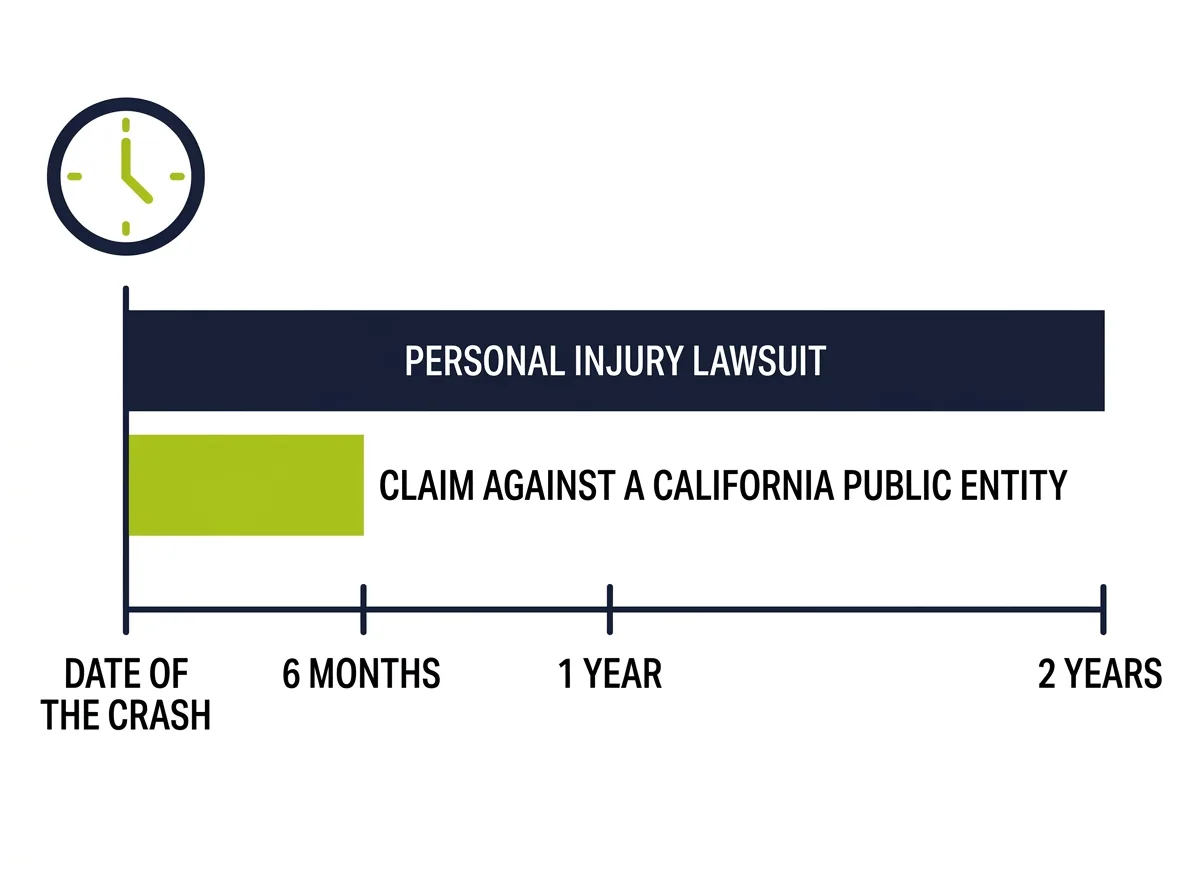
It is also the wrong number to plan around, and the gap between those two statements has cost people real money.
Start with what the two years actually are. It is not two years to decide whether to hire someone. It is not two years to finish treating and then think about it. What you really have is two years to file a lawsuit, and everything that has to happen before a lawsuit can be filed properly must occur within that window.
Why the Technical Deadline Is a Trap
Here is what makes it tricky. Many cases are very complex. There is a lot going on. Maybe it is finding the right defendant. Maybe it is proving the right elements of the case so you can actually be successful. Whatever it might be, that work takes time and requires access to evidence that is still available.
What happens is that people wait so long that a lawyer coming in near the end has to distill all of those complex problems down at once. That makes it genuinely hard to jump in at the last minute and give you good advice, handle the case, and get out in front of the defense, because they have already had a two-year head start on you as the client and on your lawyer.
Think about what that head start means in practice. The other side's carrier opened a file the week of the crash. They took statements while memories were fresh. They know what their exposure looks like. Meanwhile, the claim sat.
The two years might be the technical deadline, but it's a very foolish deadline if you actually want a great result on your case and to alleviate those two years of massive stress. You really not only benefit the case, but you benefit your own well-being by getting a lawyer right up top.
There is a second cost in there worth naming, because it does not show up in any settlement calculation. Two years of carrying it yourself is two years of stress. Either the stress of knowing you should hire a lawyer and putting it off, or the stress of handling the day-to-day yourself, the conversations with defendants and insurance adjusters, or simply living with the fear of not knowing what is going to happen or what you should do.
When the Clock Is Much Shorter
There are situations where you do not have two years, and you can walk into them without realizing it.
If a city, a county, a sheriff's department, a school district, a transit agency, or the State of California is involved, you are under the California Government Claims Act. You generally have six months from the date of the crash to present a written claim to that entity, though a late claim can be filed within one year. A claim is not a lawsuit. It is a form filed with the agency, and it is a precondition to being allowed to sue at all.
What happens after you file it is where these cases are won or lost. The entity has forty-five days to accept or reject the claim. If it sends you a written rejection, you have six months from that rejection to file suit, rather than the two years you would have in an ordinary case. People file the claim correctly, get the rejection letter, assume the regular statute still protects them, and lose the case on a deadline they had already met once.
If you miss the six-month claim deadline, there is a procedure to apply for permission to file late, and it has to be used within a year. Still, it is best to file the claim in a timely manner and avoid needing to request to file a late claim.
Federal agencies are different again, and people get this backward. A claim against the United States, a Postal Service truck, or a federal agency is governed by the Federal Tort Claims Act rather than California's. There, you have two years to present an administrative claim to the agency on a Standard Form 95, and then six months to file suit after the agency denies it. Longer than the state rule, and a completely separate process with its own requirements.
In those cases, you have to be very, very fast in contacting a lawyer and getting out ahead of it. Most lawyers are cautious about getting into that type of case late, because you can run into a number of different legal problems when the claim window has been mishandled.
Governments that write laws also write into those laws protections for themselves. So broadly speaking, government case, you have way less time.
The category is broader than people assume. A collision with a city vehicle. A crash caused by a road defect or a signal failure on a county road. An accident involving a public transit vehicle. All of those could fall within the shortened window, and the person involved usually has no idea that their case is different from any other collision.
The Deadlines, in One Place
There is more than one clock running in a car accident case. These are the ones that matter.
| What | Deadline | Running from |
|---|---|---|
| Report to the DMV on Form SR-1 | 10 days | The crash, if anyone was injured or killed, or if property damage exceeds $1,000 |
| Claim against a California public entity | 6 months | The date the claim accrued |
| Suit after rejection of that claim | 6 months | The date the rejection is served |
| Administrative claim against a federal agency | 2 years | The date the claim accrued |
| Uninsured motorist claim: sue the driver, agree in writing to arbitrate, or demand arbitration in writing | 2 years | The date of the incident |
| Personal injury lawsuit | 2 years | The date of the incident |
| Wrongful death lawsuit | 2 years | The date of death |
| Property damage lawsuit | 3 years | The date of the incident |
Three notes on that table. The SR-1 is a form you file with the DMV, separate from any police report or insurance claim, and failing to file it can cost you your license. The uninsured motorist line is the one people miss most. The claim against your own carrier has to be preserved within two years of the crash, by suing the driver who hit you, agreeing in writing to arbitrate, or demanding arbitration in writing.
And if you were a minor when you were hurt, the two-year injury deadline generally does not begin until you turn eighteen. The government claims deadline is not extended in the same way, though being a minor is grounds for filing late. A claim against a public entity on behalf of a child still requires immediate attention.
What This Means Practically
The operative rule is that the deadline that matters is the one you cannot see yet.
If there is any possibility that a government entity is involved, the case needs evaluation quickly, in weeks rather than months. And in an ordinary case, the reason to move early is not the statute at all. It is evidence, defendant identification, and not handing the other side a two-year advantage.
Common Questions
- How long do I have to file a car accident claim in California?
- Two years from the date of the accident to file a lawsuit for your injuries. That is the technical deadline, and it is not the only one. Property damage runs three years, a wrongful death claim runs two years from the date of death, a claim against a public entity runs six months, and an uninsured motorist claim has to be preserved within two years of the crash by suing the driver, agreeing in writing to arbitrate, or demanding arbitration in writing. Robert May's position is that treating any of these as the planning deadline is a mistake, because complex cases need time to develop, and the defense has been working on the file since the crash.
- How long do I have to sue a city or government agency in California?
- Far less time. A claim against a California city, county, sheriff's department, school district, transit agency, or the state must be presented to that entity within six months; a claim is a separate instrument from a lawsuit. If the entity rejects the claim in writing, you then have only six months from that written notice to file suit; if no written rejection ever comes, the lawsuit deadline is two years from the accident. Federal agencies are separate: a claim against the United States is brought under the Federal Tort Claims Act, which allows 2 years to present the claim and 6 months to sue after it is denied. All of these need attention immediately.
- What happens if I wait too long to hire a lawyer?
- The case gets harder rather than impossible, until the deadline runs. Evidence degrades, witnesses become difficult to locate, and a lawyer brought in late has to solve complex problems under time pressure. Many lawyers are cautious about accepting cases late for exactly that reason.
- Should I wait until I finish medical treatment to contact a lawyer?
- No. Representation and treatment run in parallel. Waiting until treatment concludes can consume most of the useful window, leaving evidence gathering, defendant identification, and insurer communication unaddressed during the period when they matter most.
Chapter Reflection
Two years is the statute. It is not the plan. The work that determines what a case is worth happens early, and the party that starts early is currently the other side. If there is any chance a public entity is involved, in most cases, the timeline is not two years at all, and that is the version of this chapter that cannot wait.