A contingency fee is one of the few pricing structures in professional services where the person doing the work gets paid only if the work produces a result. It is worth understanding precisely, because the structure itself is what makes representation available to people who could not otherwise afford it.
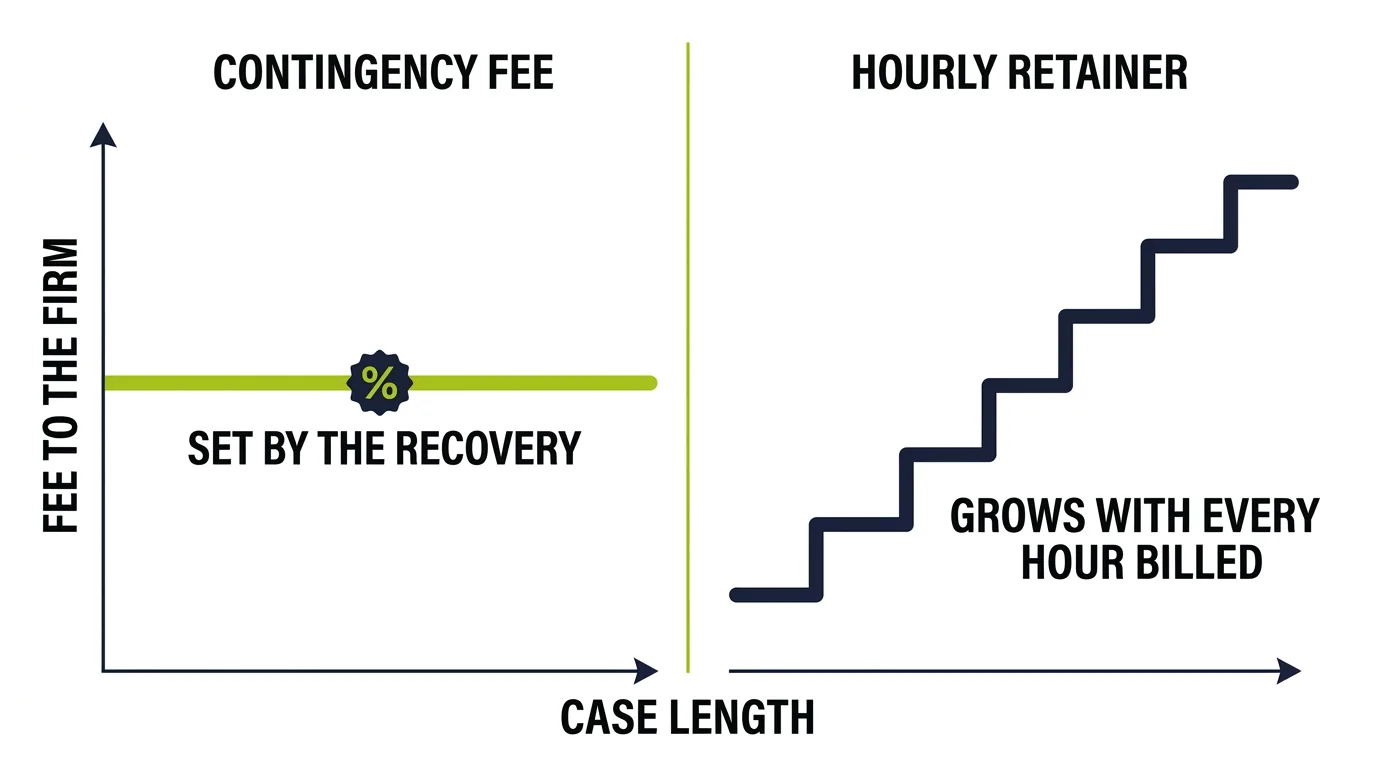
In a California car accident case, it works like this. Your lawyer is paid a percentage of whatever the gross recovery is. In the event there is no recovery, there is, of course, no fee. The percentage is stated in your client agreement; it should be clearly outlined there, and the lawyer can never take more than that.
That is the whole mechanism. Everything else people worry about sits in the details around it, which the next several chapters cover.
Unlike many other areas of law where you might have a large retainer, or in a family law case, the longer I work on a case, the more hours I bill, the better it is for the law practice. Whereas in a contingency fee case, the most efficient way from point A to point B with the most significant recovery is going to be the best for the client, and it also works out to be the best for the law firm.
Why the Incentive Structure Matters More Than the Percentage
Most lawyers bill by the hour, often against a retainer paid up front by the client. That structure has an uncomfortable truth: A lawyer billing hourly makes more money, the longer the case runs, and the more hours are billed. The client's interest in resolution and the firm's interest in collecting fees point in opposite directions.
A contingency fee inverts that. The fee is a percentage of the recovery, so the larger the recovery, the larger the fee. Meaning your attorney's interests are deeply aligned with your interests. There is a direct correlation between your success and the firm's success.
It also means efficiency is rewarded rather than penalized. The most efficient path from point A to point B with the greatest recovery is the best outcome for the client and, at the same time, for the law firm. A firm that drags a case out is not making more money; it is making the same money later while carrying more costs.
No Recovery, No Fee, and What That Actually Means
The phrase gets used loosely in advertising, so it is worth being precise about what it covers.
If there is no recovery on the case, there is no attorney's fee. That part is straightforward, and it is universal in contingency work. What varies between firms, and what people do not always ask about, is the treatment of case costs, which are a separate category of money entirely and are the subject of Chapter 5.
The other thing to understand is that the fee attaches to the gross recovery, not to what lands in your account. That is not a trick; it is just the arithmetic, and it is why Chapter 7 exists.
Read the Agreement, Because the Agreement Governs
The percentage should be very clearly outlined in your client agreement, and the lawyer can never take more than what that document says.
That makes the agreement the single most important piece of paper in the relationship, and it is worth reading before you sign it rather than after. The next chapter covers what the California baseline actually is and what to watch for in agreements that depart from it.
Common Questions
- How does a contingency fee work in a California car accident case?
- The lawyer is paid a percentage of the gross recovery. If there is no recovery, there is no fee. The percentage is set in the client agreement, and the lawyer cannot take more than the amount stated there. That structure is what allows someone to be represented without paying anything up front.
- Do I pay anything up front to hire a car accident lawyer?
- No. There is no retainer in a contingency fee case. The firm is paid at the end, out of the recovery, and if the case does not recover, there is no fee. Case costs are handled separately and are covered in Chapter 5.
- Can my lawyer charge more than the percentage in the agreement?
- No. The percentage stated in the client agreement is the ceiling, and the lawyer can never take more than that. This is one of the reasons to read the agreement carefully before signing, including any language about how the percentage changes at different stages of the case.
- Why do personal injury lawyers work on contingency instead of hourly?
- Because it aligns the incentives. Under an hourly model, more hours worked is better for the firm. Under a contingency model, the firm does better when the client does better, and the most efficient path to the largest recovery serves both. It also means people who cannot pay a retainer can still be represented.
Chapter Reflection
The structure is simple: a percentage of the gross recovery, capped by the agreement, owed only if there is a recovery. Its real function is alignment, because it ties the firm's outcome to yours rather than to the clock. What the percentage actually is, and what makes it move, is the next chapter.