An unrepresented claim and a represented claim are handled by the same company, often by the same adjuster, and they are handled completely differently. Understanding why is the most useful thing a person can know before they pick up the phone to an insurer.
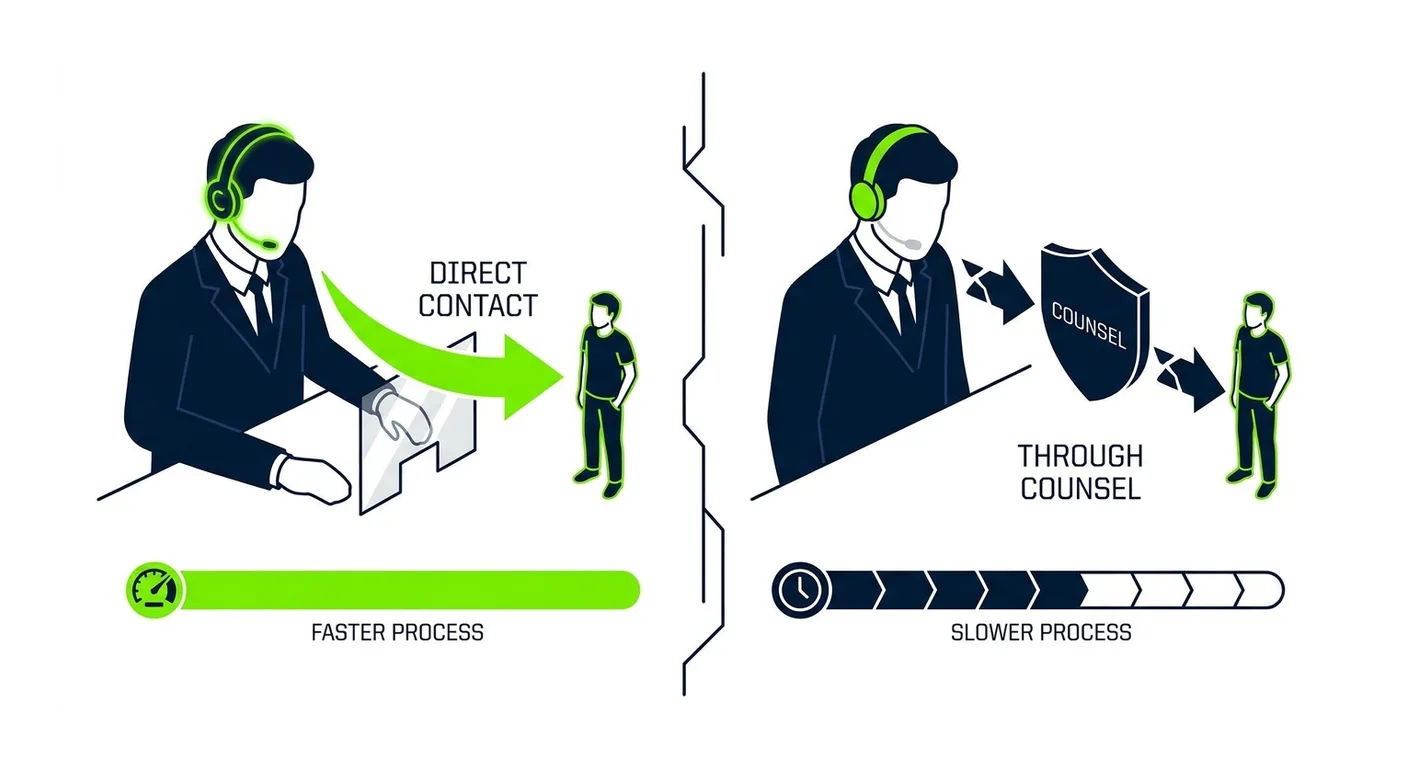
An unrepresented claim, I always think of it almost like a grenade they're trying to jump on. They're going to act as quickly as possible to limit damage. They're going to put pressure on the injury victim to settle their case, take a nominal amount of money so they can close that case file.
The grenade is the correct image because it conveys speed. The exposure is largest and least defined at the beginning, so the incentive is to contain it immediately, at a nominal number, and close the file before anyone knows what the claim is worth.
On the other side, there is an injured victim. In practice, the carrier stops calling the client and deals with the lawyer, and once a lawsuit is filed, the other side's attorneys are barred from contacting you directly. They get only the information the lawyer thinks they are entitled to. And they know each and every avenue is going to be prosecuted by the lawyer on behalf of the client.
That is a different negotiation, with a different set of assumptions behind it.
Recorded Statements
At The May Firm, we see two insurance companies involved in most car accident cases, and the advice differs for each.
The other driver's carrier owes you nothing, and you owe them nothing. If you are unrepresented, we always advise against giving them a recorded statement.
You could say your name and the date of the accident. When it comes to medical treatment, you could say something as simple as "I am seeking my own medical care" and leave it at that. You would not want to start adding specific injuries or specific facts around the accident or the underlying incident.
Your own insurance carrier is different, and that catches people off guard. Your policy almost certainly contains a duty to cooperate, which means refusing to talk to your own insurer can put your own coverage at risk, including the uninsured motorist coverage that may turn out to be the largest source of recovery in your case. The answer is not to refuse. It is to have your lawyer handle that communication, which is one of the first things we do.
In reality, it is very difficult for people to do.
Human beings are very agreeable by nature. They don't like to be combative, and so they want to answer questions even when it's not in their best interest. I've never had a client give a statement and at the end thought, that really helped this case out.
Any criminal defense lawyer will say, "Say nothing." Civil lawyers say effectively the same thing, for the same reason. A recorded statement taken in week one, before the full injury picture exists, becomes a fixed record that is read back later against a claim that has developed since then.
Social Media
A client's social media activity can almost only hurt the case.
Consider a serious case where the client simply had a big smile in a photograph. A defense neurologist pointed to it. Look how happy they are. A photograph and a smile certainly do not speak to the underlying pain a human being is going through, but it became something to argue about.
The reverse does not help either. People rarely post complaints and ailments, and posting them looks manufactured. If you are making posts about your neck hurting and your back hurting, it seems fake, like you are trying to build your own case through the public.
So the advice is simple. Talk to your lawyer, talk to your doctors, and keep the case where it needs to be. Manage your feelings with your friends and the people around you. Do not advertise your pain, and do not be out hiking and putting it on the internet. I have never seen social media help any client. Make it private, and stop posting about it.
Insurance Bad Faith
Insurance bad faith is a complicated and extensive area of the law, and the version worth understanding here is broad.
Broadly speaking, insurance bad faith means the insurance carrier, often your own carrier, has acted in a way that is indefensible, meaning they have not protected the rights of whoever they insure. That can expose them to verdicts or settlements that exceed the underlying policy limits.
The May Firm has had cases where the policy was one hundred thousand dollars, and the recovery went far beyond that because the carrier acted in what we would call bad faith. Sometimes you hear the term opening the policy, meaning going from whatever the underlying limit was to well past it.
One thing worth understanding about how that works. As the injured person, you generally cannot sue the other driver's insurance company directly for bad faith in California. What happens instead is that the carrier refuses a reasonable demand within its policy limits, the insured ends up with a judgment larger than the policy, and that insured has a claim against their carrier, which can be assigned to the injured person. That is the path. It is narrower than it sounds and entirely case-specific, which is why a policy limit is not always the ceiling people assume it is.
The details and idiosyncrasies of bad faith law take a much more significant legal discussion than this chapter allows. What matters for a reader is that a policy limit is not always the ceiling people assume it is, and whether that door exists in your case is something counsel evaluates.
Common Questions
- Should I give a recorded statement to the insurance company?
- To the other driver's carrier, no. You can confirm your name and the date of the accident, and say you are seeking your own medical care. Avoid describing specific injuries or facts about the accident, because that record gets used later against a claim that is still developing. Your own insurer is a different matter, because your policy requires you to cooperate with it. Do not simply refuse that one. Have your lawyer handle it.
- Can social media hurt my car accident case?
- Yes, and it rarely helps. A single photograph has been used by a defense expert to argue a client was not suffering. Posting about pain reads as manufactured. Robert May's advice is to make accounts private and stop posting about the case entirely.
- Why do insurance companies treat represented claims differently?
- Because the dynamic changes. Once a lawyer is involved, the insurer can only communicate through counsel, receives only the information the lawyer provides, and knows every avenue will be pursued. Without representation, the incentive is to close the file quickly at a nominal number.
- What is insurance bad faith?
- Broadly, it means the carrier acted indefensibly and failed to protect its insured's rights. It can expose the insurer beyond the policy limits, which is sometimes called opening the policy. It is a complex area, and whether it applies is a case-specific evaluation.
Chapter Reflection
The insurer's behavior is not personal; it is procedural. Speed and pressure against an unrepresented claim, caution and process against a represented one. Which means the two things most within your control right now are saying very little on the record and keeping the case off the internet.