What a Car Accident Case Is Worth, and How a Demand Letter Argues It
When it comes down to what a case is worth, the first question is not a legal one.
If you are the client, what has your life been like? How has it been changed? What has it been like for you, day by day, to live?
That is where the valuation starts, and it is deliberately not where most people expect it to start. They expect a formula, some multiplier applied to medical bills. The bills are part of it. They are not the center of it.
The Accounting Side
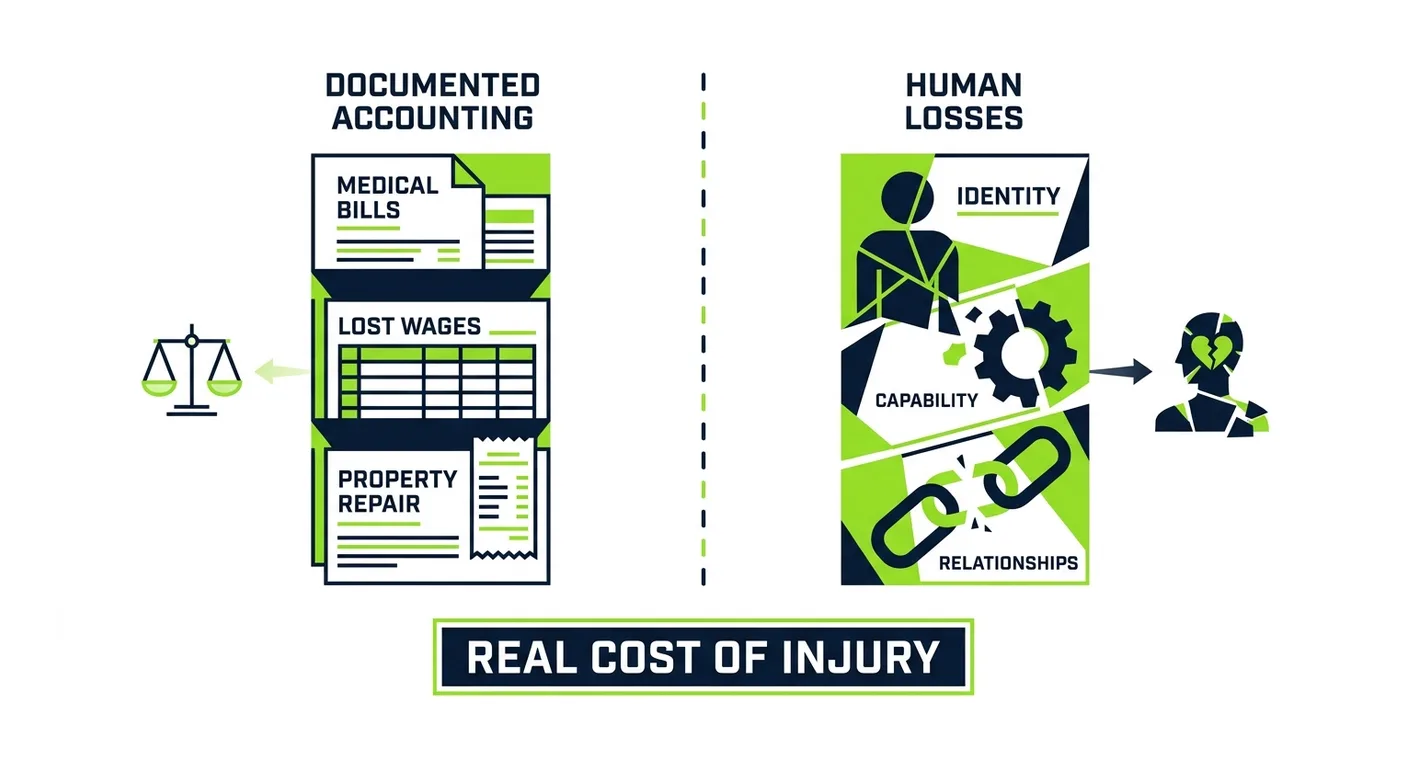
There are economic factors, and it is useful to think of those as debts incurred. They can also incur losses due to being unable to work.
I would almost look at it like an accounting. They are like your personal injury taxes. What are all the numbers and items that you spent, that you lost, that have to be accounted for?
That is the part of a case that gets documented rather than argued. Medical expenses to date and expected going forward, lost wages, lost earning capacity if the injury changes what you are able to do. It is assembled from records, and its accuracy depends on whether someone has been collecting those records throughout.
The Human Side
Then there is the other category, the one that carries the weight in a serious case.
There's something called non-economic damages. Those are human damages. Those are the real costs of being injured. They are brain injuries in which your memory is gone, and your ability to enjoy things has changed. It's the loss of identity, it's the loss of joy, it's the loss of relationship, family, all those other things.
Notice what that list is made of. Not diagnoses. Losses. The person who trained, competed, and now walks the same road. The memory that does not return. The relationships that change because the person inside them changed.
Those are the real costs of being injured, and they are harder to prove than a bill because there is no invoice for them. They get proven through the specific texture of a particular life before and after, which is why the question at the top of this chapter is the one that opens the valuation.
The Demand Letter
The place where all of this gets assembled into an argument is the demand letter.
At The May Firm, we write demand letters in cases, and, simply put, they are almost like opening statements for your case.
It's almost like an opening statement for your case. If you've ever watched a jury trial, there's an opening statement. Your lawyer will stand up and give the jury a roadmap so they know what to expect. There's going to be a narrative. It's really a story about you.
The structure follows that logic. You start with what occurred, what the incident was, and how we got here. By the end, it is where we are at today and, ultimately, what constitutes just compensation for everything from the beginning to the end.
A demand is generally written and has parts. There is a narrative, which is really a story about you. Then there is the evidence, going back to the losses incurred, the economic losses, and the personal ones. In our cases, we like to include videos to tell a story and a narrative, so the other side understands what to expect down the road, probably at trial.
And then it is a way of asking for fair economic compensation, in a somewhat more informal way. Informal, but not without considerable time dedicated, thought dedicated, and an intention to be very specific to the client.
That last clause is the difference between a demand that moves a number and one that does not. A form letter with an attached bill summary tells the carrier nothing it did not already know. A demand built as an opening statement tells the jury what to expect.
Common Questions
- How do lawyers determine what a car accident case is worth?
- It starts with how the client's life has actually changed. Economic damages are the accounting: what was spent, what was lost, what could not be earned. Non-economic damages cover the human losses, including loss of identity, joy, and relationships. Both sides of that get assembled before any number is put forward.
- What are non-economic damages in California?
- They are the human costs of an injury rather than the financial ones. Robert May describes them concretely: memory lost to a brain injury, a spine injury that ends the activities that defined someone, and the loss of identity, joy, and relationships that follows.
- What is a demand letter in a personal injury case?
- It is a written demand structured like an opening statement at trial. It sets out what happened, where things stand today, the evidence behind the economic and personal losses, and what just compensation would be. The May Firm often includes video so that the other side can see what a jury would see.
- Why does it matter that a lawyer writes the demand letter?
- Because the demand is an argument, not a bill summary. It requires considerable time and thought, and it has to be specific to the client to be persuasive. A demand that reads like a form letter gives the carrier no reason to move off its evaluation.
Chapter Reflection
Valuation begins with the life, not the ledger. The ledger is assembled, the human losses are established, and the demand letter presents both to the other side as a story with supporting evidence. What happens after that demand is the last stretch of the case.