
Fees and costs are two different things, and conflating them is the most common misunderstanding people bring into a fee conversation.
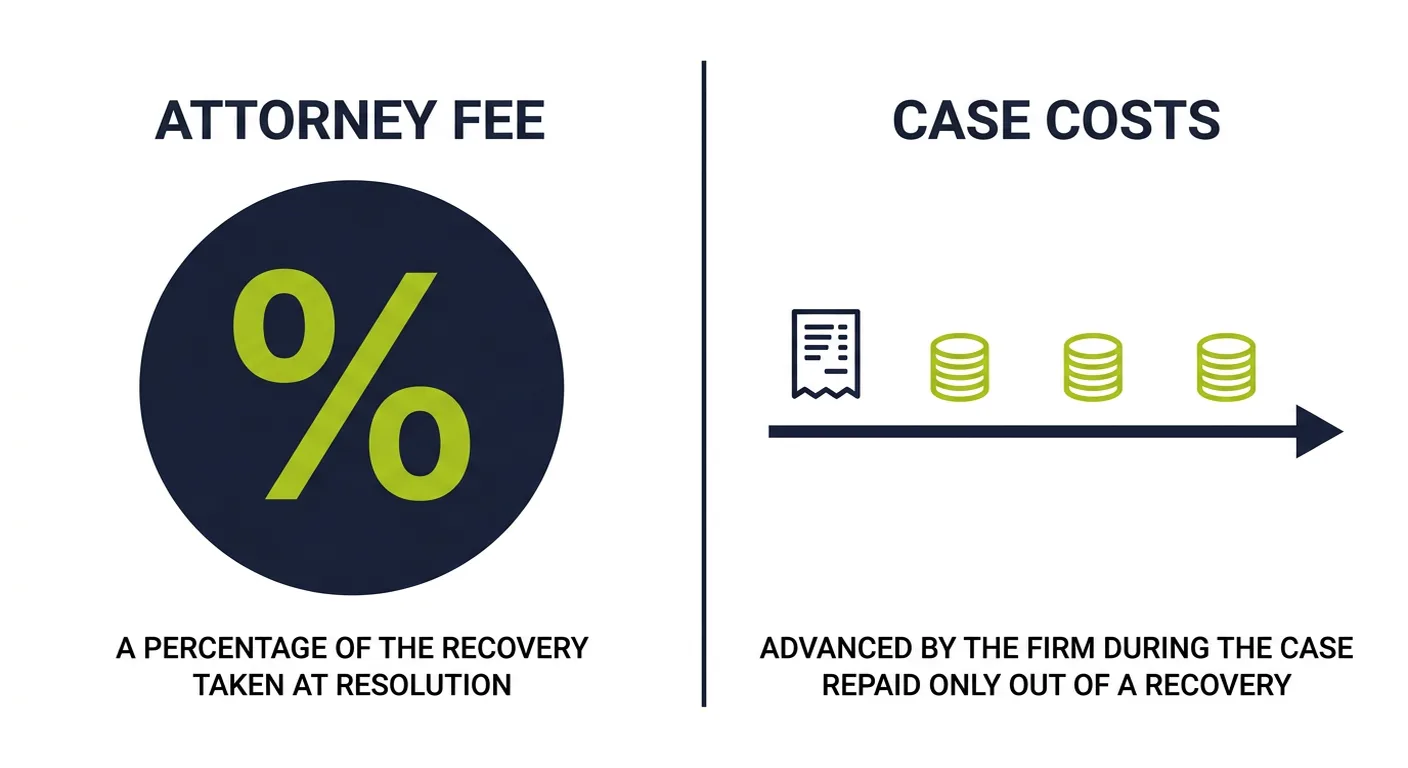
Fees are paid at the end of the case. They are a percentage of the gross recovery, as covered in the last two chapters.
Costs are something else entirely. The costs are effectively a zero percent loan that the lawyer is paying throughout the case. They are the funds spent to move the case forward, advanced by the firm as the case proceeds, and repaid from the recovery at the end.
What Case Costs Actually Are
The range is wide and scales with the case's requirements.
Initial costs are simple. Getting a traffic collision report might cost twenty dollars. From there, it climbs, and in a case that needs it, hiring some of the best experts in America can cost $20,000, $40,000, $60,000, or $100,000.
The costs are what the lawyer pays out of pocket in what they believe is in the client's best interest to advance the case and, ultimately, to increase the recovery. An accident reconstructionist, a biomechanical expert, a life care planner, treating physician testimony, deposition transcripts, court filing fees, all of it lands in this category. None of it is optional if the case needs it, and none of it is free.
At the end of the case, the law firm is paid back the money it has invested. That is a cost recovery, not a profit center. It is not a money-making enterprise; it is simply the firm getting back what it laid out.
In the event your case is unsuccessful, maybe you don't win at trial, or there ultimately is no recovery on the case for whatever reason, the client does not pay the law firm back. So that's the risk the law firm is taking by accepting your case, working on a contingency. They're also saying, 'We believe in you. We bet on you. We're going to invest in your case in the interest of the best outcome possible.'
Who Absorbs the Loss
This is the part that changes how people understand the arrangement.
If the case is unsuccessful or there is no recovery for any reason, the client does not repay the firm for the advance costs. The firm absorbs them.
That is the actual risk a contingency firm takes when it accepts a case. It is not only forgoing a fee, but it is also writing off real money it has already spent. And so a firm accepting your case on those terms is making a statement about the case. It is saying it believes in the case enough to invest in it and bet its own capital on an outcome it does not control.
It also explains something that people find puzzling: why firms decline cases that seem meritorious. Every case accepted carries a cost exposure the firm cannot recover if the case fails, which means intake is a capital allocation decision as much as a legal one.
Why This Should Be in Writing
Because legal costs vary across firms, the client agreement should be explicit about who bears the costs in the event of a loss.
Ask the question directly in the consultation. If the case does not recover, do I owe the firm anything? It is a one-sentence question with a one-sentence answer, and the answer belongs in the document you sign.
Common Questions
- What is the difference between attorney fees and case costs?
- Fees are the attorney's percentage of the gross recovery, paid at the end of the case. Costs are money the firm advances during the case to move it forward, from a twenty-dollar traffic collision report up to expert fees that can reach tens of thousands of dollars. Costs are reimbursed to the firm out of the recovery, separately from the fee.
- Who pays the case costs if I lose my car accident case?
- At The May Firm, the client does not pay the firm back if there is no recovery. That is the risk the firm takes by accepting the case on a contingency basis. Cost treatment can vary between firms, so confirm it in the agreement before signing.
- How much do case costs run in a car accident case?
- It depends entirely on what the case requires. Simple costs start with items like a traffic collision report. Cases that need serious expert work can run twenty, forty, sixty, or a hundred thousand dollars in expert fees alone. The firm advances these as the case proceeds.
- Do case costs come out before or after the attorney's fee?
- Both fees and costs are deducted from the gross recovery, along with medical expenses and any insurance reimbursement. Chapter 7 walks through the full sequence so you can see how a gross number becomes a net one.
Chapter Reflection
The fee is the percentage. The costs are the investment, advanced at the firm's risk and repaid only out of a successful outcome. Understanding that split matters because it explains what a firm is actually putting at stake when it takes your case, and it sets up the arithmetic that decides what you take home.